Choosing the right welding method directly impacts strength, structural stability, deformation control, and production feasibility. Our welding manufacturing services are ideally suited for metal structures, frames, brackets, pipes, sheets, and custom components that require strong connections and reliable dimensional stability. They are the perfect choice for mechanical parts, automotive structures, construction equipment components, and industrial frames.
I. Core Welding Capabilities
1. Material Compatibility
Carbon steel, alloy steel, stainless steel, structural pipes, aluminum
2. Welding Methods
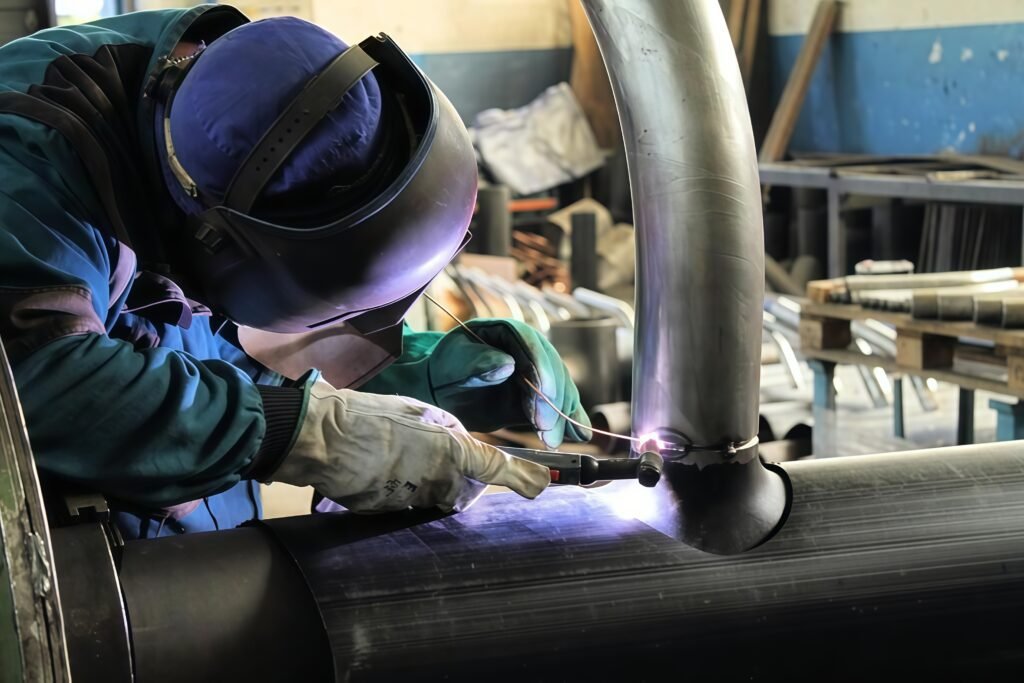
MIG Welding / TIG Welding / Shielded Metal Arc Welding (SMAW) / Robotic Welding
3. Joint Types
Fillet Joint, Butt Joint, Lap Joint, T-Joint, Pipe-to-Pipe Joint, Pipe-to-Plate Joint
4. Welding Size Range
Fillet welds: typically 2–10 mm; Full penetration welds available upon request
5. Maximum Assembly Size
Up to 4000 mm depending on structure and fixtures
6. Distortion Control
Preheating, controlled heat input, fixture clamping, staggered welding
II. Welding Assembly Services
Designed specifically for medium to high-volume production of welded components, our welding assembly services ensure consistent alignment of weldments, clean weld appearance, and repeatable strength. They are suitable for frames, enclosures, shields, bases, pipe assemblies, and multi-component welded structures.
1. Fixture-Based Precision
Typical assembly precision: ±1.0mm (higher precision achievable with custom fixtures)
2. Post-Welding Processing
Milling, drilling, tapping, post-welding hole correction
3. Surface Treatment
Sandblasting, powder coating, painting, galvanizing
4. Inspection Methods
Visual inspection, dimensional inspection, fillet measurement, non-destructive testing (PT/MT/UT) available upon request
5. Batch Capacity
Prototype: 1-20 units · Small Batch: 50-500 units · Mass Production: 500+ units
6. Weld Appearance Control
Post-TIG welding finishing, weld uniformity, spatter removal, and optional weld grinding (for cosmetic or exposed components)
III. Welding Capabilities & Quality Standards
Our welding services prioritize structural strength, dimensional stability, and consistent repeatable quality. The following specifications reflect the key performance factors that buyers rely on when evaluating welding service providers.
1. Welding Standards Compliance
All welding processes adhere to ISO 3834, AWS D1.1, or EN ISO 9606 standards, as required by the project scope or customer technical drawings.
2. Supported Welding Technologies
We offer MIG welding, TIG welding, Shielded Metal Arc Welding (SMAW), and robotic welding. The selection of welding method is determined based on factors such as required strength, surface appearance, heat input control, and material type.
3. Dimensional Accuracy Assurance
Fixture-based positioning ensures an assembly precision of ±1.0mm for most welded frames. For applications requiring tighter tolerances, custom fixtures can be used to achieve higher alignment accuracy.
4. Distortion & Warpage Control
We implement multiple distortion control measures, including precise heat input management, staggered welding sequences, preheating procedures, interpass cleaning, and calibrated clamping fixtures, to minimize deformation and warpage of workpieces.
5. Weld Penetration & Strength
For visible components, we guarantee a uniform weld appearance. TIG welding is exclusively used for applications with high cosmetic requirements. Optional weld grinding and polishing services are available to meet specific surface finish demands.
6. Production Capacity & Scalability
Our production capabilities cover various order scales: Prototype (1-20 sets), Small Batch (50-500 sets), and Mass Production (500+ sets). For mass production orders, we utilize dedicated fixtures and optimized welding parameters to ensure efficiency and consistency.
7. Quality Inspection Protocols
Standard inspection methods include visual inspection, dimensional measurement, and fillet size verification. Upon customer request, we also provide non-destructive testing (NDT) services such as Penetrant Testing (PT), Magnetic Particle Testing (MT), and Ultrasonic Testing (UT).